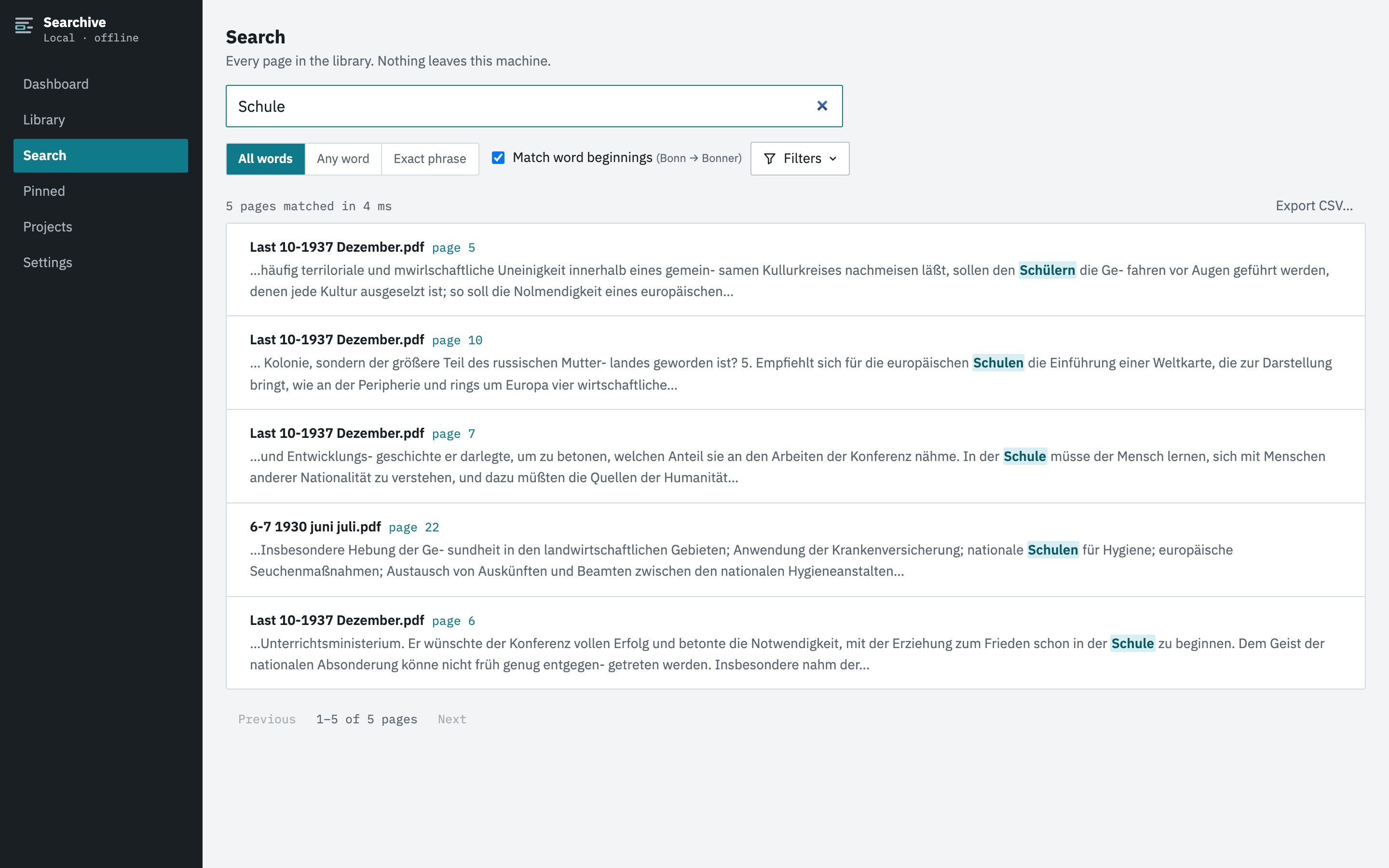
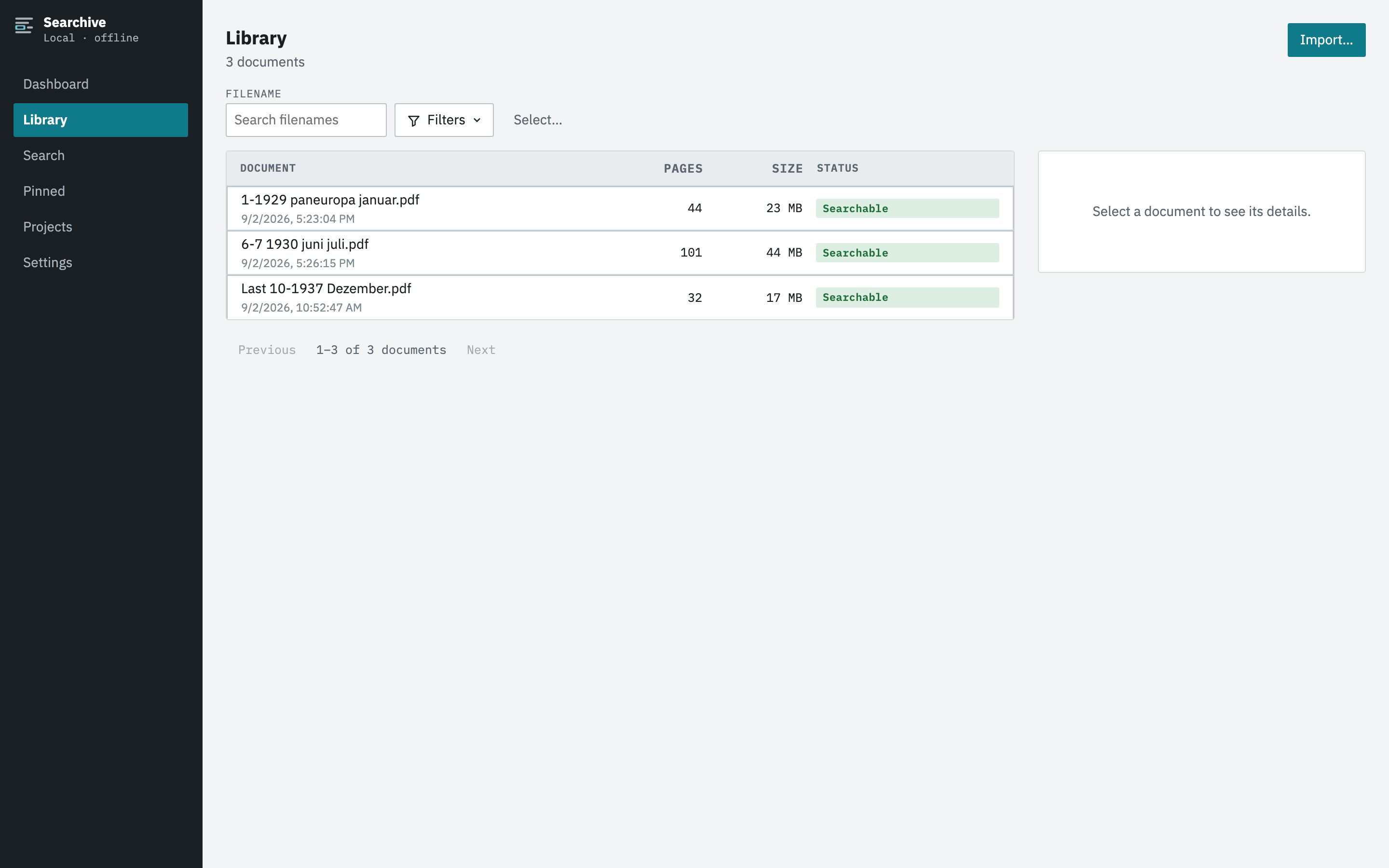
Import the PDFs, let it read them — German, French, English, Dutch, even century-old print — and find any word on any page. Entirely on your own computer.
Launching soon for macOS and Windows. One email when it ships — nothing else.
Folders of scanned journals, church registers, correspondence, city records — thousands of pages you photographed in archives or inherited as PDFs. Finding one name in them means reading all of them. Cloud OCR services would do it, but they want your documents uploaded to someone else's computer.
Single files, whole folders, or the photos you took in the archive: a set of phone photos becomes one document, pages in camera order. Your originals are never modified.
Text recognition tuned per document, in the language the document is written in — including old orthography and diacritics.
Full-text search across every page in your library, with matches highlighted on the scan itself — you read the original, not a transcription. Search all words, any word (Cöln, Köln and Coeln in one go), or an exact phrase.
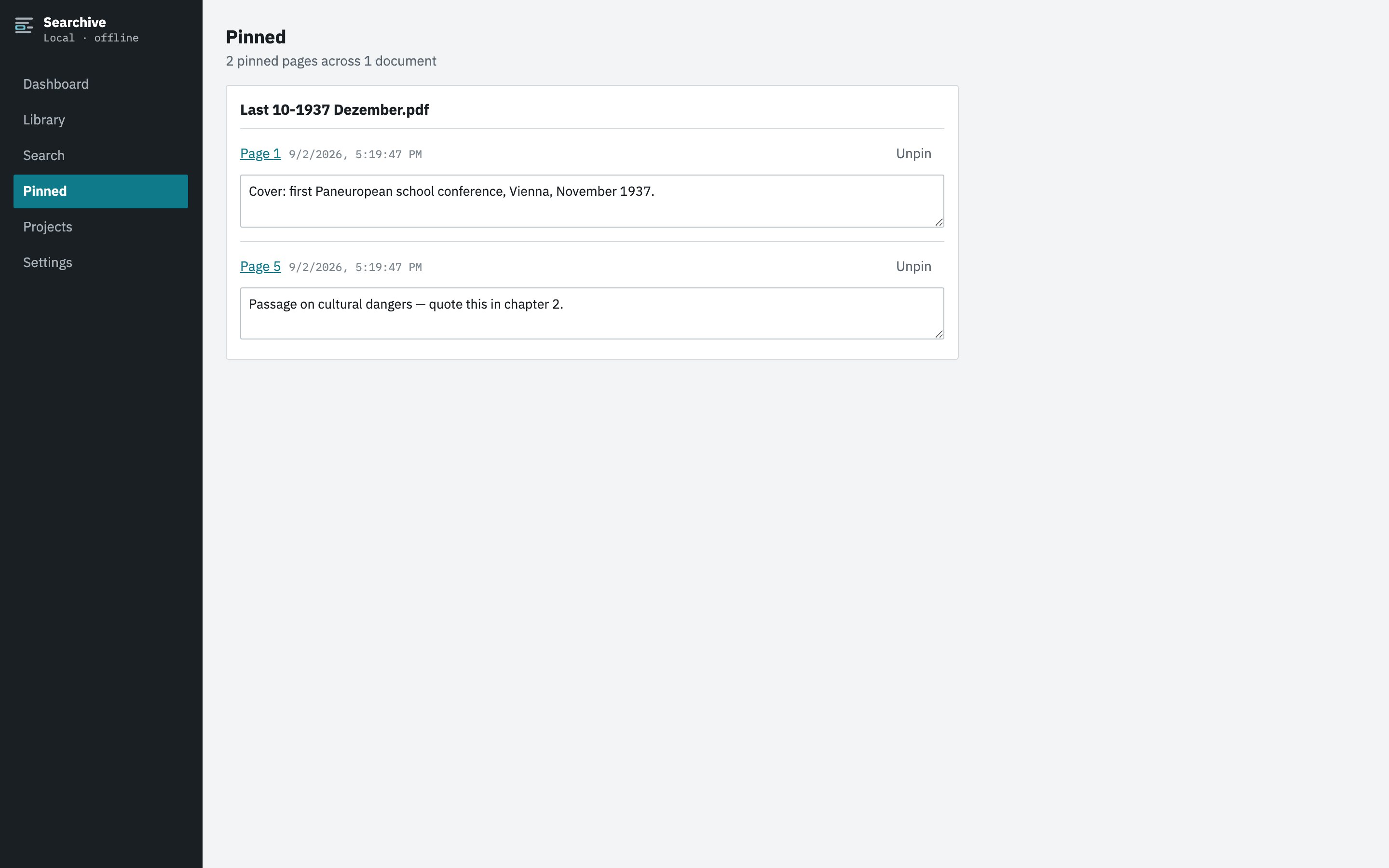
Pin the pages that matter with a note in your own words — your findings, collected in one place. Export any search's results as a CSV for your notes or source list. Projects to group your sources, per-page read-quality flags so you know which pages to double-check and metadata that always says whether the document stated it or the app inferred it.


The documents, the recognized text, the search index — all of it lives in a folder on your own computer. No uploads, no accounts, no analytics. It works with the network cable unplugged.
In the archive basement, on the train, anywhere. Nothing about it needs a connection.
One ordinary folder holds everything. Back it up, move it, open it — no lock-in, no proprietary vault.
If you ever stop subscribing, reading, searching and exporting your library keep working. Forever.
Pay yearly and get two months free. The plans differ only in library size — features are never the dividing line. The free plan is the full product on one document: search it, pin it, export from it, for as long as you like.
Searchive began as one Dutch household's problem: a historian with thousands of scanned pages — journals, registers, correspondence in four languages — and no way to search any of it. The cloud services that could read them wanted the archive uploaded first and a century of papers on someone else's servers felt wrong. So the programmer across the table built the tool they couldn't find: fast, complete and entirely on your own machine.
That's still the whole company — a researcher and an IT engineer in the Netherlands. There is no support department; mail sent to info@searchive.io is read and answered by us.
Your library stays readable, searchable and exportable — forever. Importing new documents and running recognition pause until you subscribe again. Your own research is never held hostage to a subscription.
Yes. Recognition and search run entirely on your machine. A subscription is confirmed with a brief online check that sends your license key and nothing else — no document data, no filenames, no search terms — and the app then works offline for weeks at a time.
Free desktop indexers tell you a word occurs somewhere in a file and leave you to open it and hunt for the page. Searchive opens the scanned page itself with every match highlighted on the image. And historical text is full of the characters those tools stumble over: names like l'église, Sa'ud or d'Annunzio, accents, quotation marks. Searchive finds them — typed with or without the apostrophe, with or without the accent — and that behaviour is covered by tests, not luck. Add photo import, projects, pinned pages with your own notes and CSV export of your findings and the difference is the one between an index and a research tool.
Yes. Select the photos of a document and they become one searchable document, pages in the order the camera took them. JPEG, PNG, TIFF and WebP are supported.
German, French, English and Dutch, chosen per document — a French letter and a German newspaper in the same library each get read in their own language. More languages are planned.
Good enough to search by: clean twentieth-century print recognizes nearly perfectly and every page gets a confidence score so you can see which pages deserve a second look. Handwriting is not supported.
macOS (Apple Silicon) and Windows 10 or later, 64-bit. It is a normal desktop application — one installer, no dependencies to set up.
In a single folder you choose — your originals, the searchable copies and the index database. Point your backup tool at it and everything is covered.